
Few complications in modern horology strike as perfect a balance between genuine utility and everyday wearability as the GMT. Part tool, part travel companion, part design statement, a GMT watch answers a deceptively simple question: what time is it somewhere else? For pilots crossing oceans, for professionals coordinating across continents, and for collectors drawn to the romance of the Jet Age, the GMT has become one of the most beloved and accessible complications in luxury watchmaking.
Yet the term itself is often misunderstood. “GMT” is used loosely to describe everything from a simple second-time-zone hand to a full world timer, and the distinctions between movement types matter far more than many wearers realize. This guide unpacks what a GMT watch actually is, where it came from, how it works, and why it continues to fascinate enthusiasts and beginners alike.
The History and Purpose of GMT Watches
The story of the GMT watch begins not in a watchmaker’s workshop but in the cockpit of a commercial airliner. In the early 1950s, the Jet Age arrived, and long-haul flight suddenly shrank the world. Pilots flying across multiple time zones needed a reliable way to track both local time and a fixed reference time—typically Greenwich Mean Time—without juggling multiple watches or performing mental arithmetic at altitude.
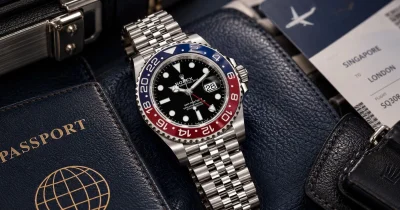
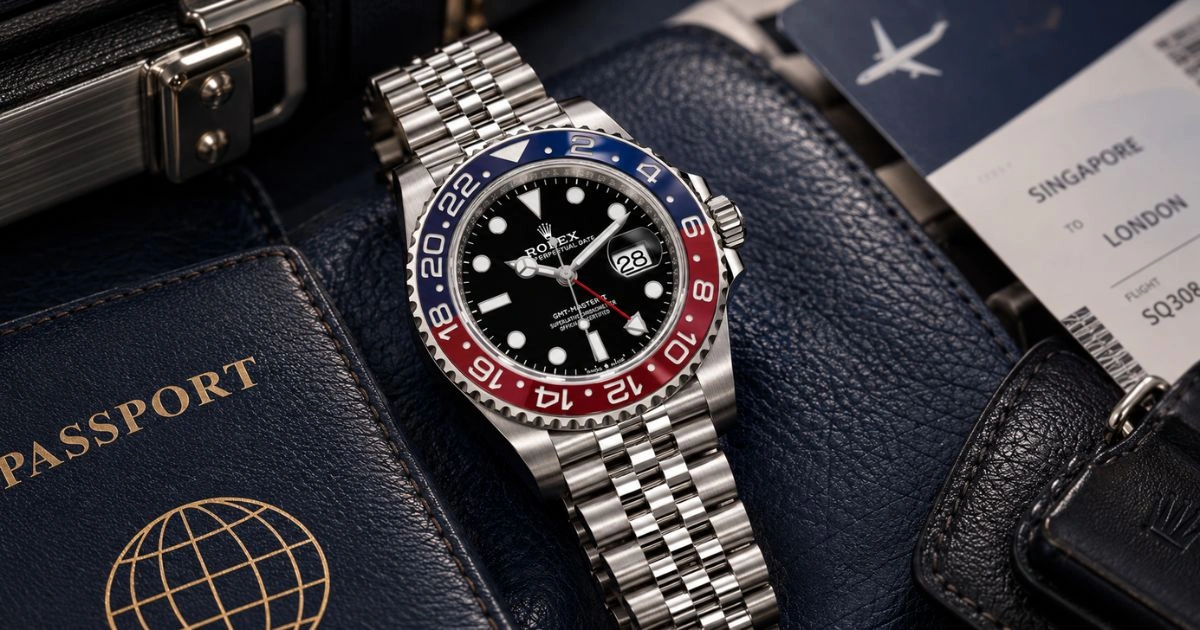
Glycine is widely credited with introducing the first watch designed for this purpose. Its Airman, unveiled in 1953, displayed time in a 24-hour format on the dial and used a rotating 24-hour bezel to track a second time zone. The Airman was ingenious, but it was Rolex’s response that would define the category. Working with Pan American World Airways, Rolex introduced the GMT-Master in 1954, a watch that combined a conventional 12-hour local display with an additional 24-hour hand and a rotating bezel. The GMT-Master’s red-and-blue “Pepsi” bezel, legend has it, was inspired by the colors of the sky at dusk—a poetic touch for a watch built to chase the sun around the globe.
The original GMT-Master’s movement, the caliber 1036, did not allow the 24-hour hand to be set independently. The GMT hand was slaved to the local hour hand, and the bezel did the work of setting a second time zone. This remained the norm until 1983, when Rolex introduced the GMT-Master II. Its movement allowed the local hour hand to jump independently in one-hour increments without disturbing the minute hand, seconds, or the 24-hour hand. That seemingly small mechanical change transformed the GMT from a pilot’s instrument into a genuinely practical travel watch, and it set the template that most modern GMTs still follow.
How a GMT Watch Works
At its core, a GMT watch is a mechanical solution to a simple problem: displaying two time zones on a single dial. The architecture rests on three essential elements: a dedicated 24-hour hand, a 24-hour scale, and, in most cases, a rotating bezel.
The 24-Hour Hand
The defining feature of a GMT watch is the fourth hand—the GMT hand—which completes one full rotation of the dial every 24 hours, moving at half the speed of the conventional hour hand. Because it operates on a 24-hour cycle, it removes the ambiguity of AM and PM. When the GMT hand points to 18 on a 24-hour scale, it is unambiguously 6:00 PM, not 6:00 AM. The GMT hand is usually distinguished by a prominent arrow tip and a contrasting color or finish, making it easy to read at a glance and serving as a visual signature of the complication.
The 24-Hour Scale and Bezel
The GMT hand alone is only half the story; it needs a scale to read against. That scale can be printed on the dial, engraved on an inner ring, or mounted on a rotating bezel. The bezel is the most common and most versatile arrangement. A fixed 24-hour scale, as found on watches like the Rolex Explorer II, allows the GMT hand to display a single additional time zone. A rotating bezel, however, adds a layer of functionality: by turning the bezel, the wearer can shift the reference point and track a third time zone without touching the crown or moving any hands. This bezel-driven approach is what makes a GMT watch more than a simple dual-time watch, and it is the arrangement most enthusiasts associate with the classic GMT formula.
Caller vs. Flyer Movements
Not all GMT movements are created equal, and the distinction between “caller” and “flyer” movements is one of the most useful pieces of knowledge a prospective buyer can possess. A caller GMT—sometimes called an “office GMT”—features an independently adjustable 24-hour hand. The GMT hand can be set to a second time zone without affecting the main time, but when the local time is changed, the GMT hand moves with it. This arrangement is intuitive for someone who tracks a home time zone while remaining in one place.
A flyer GMT—also called a “true” or “traveler’s” GMT—reverses the logic. The local hour hand jumps independently in one-hour increments, forward or backward, without disturbing the minute hand, seconds, or the 24-hour hand. This is the arrangement found in the Rolex GMT-Master II, the Tudor Black Bay GMT, and the Longines Spirit Zulu Time. For frequent travelers, the flyer design is vastly more practical: landing in a new time zone requires only a few quick jumps of the local hour hand, while home time remains undisturbed on the 24-hour hand.
GMT vs. Dual Time vs. World Time
The watch world is not always precise with its vocabulary, and the GMT is a frequent victim of loose terminology. Understanding the differences between a GMT, a dual time, and a world timer is essential for anyone navigating the travel-watch landscape.
GMT Watches
A GMT watch uses a dedicated 24-hour hand and a 24-hour scale to display a second time zone in 24-hour format. This 24-hour reference is the critical distinction: it tells the wearer not only the time in another zone but also whether it is day or night there. A standard GMT with a rotating bezel can track up to three time zones: local time on the main hands, a second zone on the GMT hand against the bezel, and a third by rotating the bezel to a different offset.
Dual Time Watches
A dual time watch also displays two time zones, but it typically does so with a second 12-hour sub-dial rather than a 24-hour hand and scale. Dual time watches are often simpler to read for casual users, but they lack the day/night clarity of a proper 24-hour GMT. Without an AM/PM indicator, a 12-hour sub-dial cannot tell you whether it is morning or evening in the second zone—a meaningful drawback for anyone coordinating across continents.
World Time Watches
A world timer goes several steps further, displaying the time in all 24 time zones simultaneously. Rather than relying on a single GMT hand, a world timer uses rotating city discs or 24-hour rings to show the time in dozens of locations at once. The world timer is a magnificent complication with its own rich history, but it is a different beast: busier on the dial, often more complex to operate, and generally less legible at a glance than a clean GMT. The GMT’s genius lies in its restraint—two time zones, beautifully executed, with the option of a third for those who know how to use the bezel.
How to Read a GMT Watch: A Practical Guide
Reading a GMT watch is straightforward once the roles of the hands and bezel are clear. The most common configuration—a flyer GMT with a rotating bezel—can be understood in three simple steps.
Step One: Set the Local Time
The main hour, minute, and seconds hands display local time exactly as they would on any conventional watch. When traveling, the local hour hand is jumped forward or backward in one-hour increments until the correct local time is shown. On a flyer GMT, this adjustment leaves the GMT hand and the minute hand undisturbed.
Step Two: Read Home Time on the GMT Hand
The 24-hour hand is typically set to home time against the 24-hour scale. If the bezel is in its neutral position—with the 24-hour marker at 12 o’clock—the GMT hand can be read directly against the bezel or dial scale. A reading of 14 means 2:00 PM at home; a reading of 22 means 10:00 PM. The 24-hour format eliminates any day/night confusion.
Step Three: Use the Bezel for a Third Zone
The rotating bezel unlocks the GMT’s full potential. One elegant method, favored by many experienced wearers, is to set the GMT hand to UTC (or GMT) rather than home time, and then use the bezel to “jump” to any desired time zone by aligning the zone’s UTC offset with the 12 o’clock marker. If the GMT hand is set to UTC 0 and the wearer wants to read Geneva (UTC+1), rotating the bezel so that “1” sits at 12 o’clock allows the GMT hand to be read directly as Geneva time. To check Tokyo (UTC+9), the wearer simply rotates the bezel to place “9” at 12 o’clock. No crown manipulation, no disruption to the watch’s timekeeping—just a quick twist of the bezel. For travelers who frequently need to check multiple zones, this bezel-based method is one of the most satisfying and underused skills in watch ownership.
Popular GMT Watch Types and Notable Models
The GMT category spans an enormous range of designs, movements, and personalities, from rugged tool watches to refined dress pieces. A few archetypes and models illustrate the breadth of the genre.
The Pilot’s GMT
The pilot’s GMT is the category’s origin story. These watches prioritize legibility, a clear 24-hour scale, and often a rotating bezel with day/night coloration. The Rolex GMT-Master II remains the archetype, with its bidirectional ceramic bezel and flyer movement. The Tudor Black Bay GMT offers a compelling alternative with a similar Pepsi aesthetic and an in-house flyer movement, while the Longines Spirit Zulu Time brings a ceramic bezel, chronometer certification, and true GMT functionality to a broader audience.
The Traveler’s GMT
For the frequent flyer, the independent local-jumping hour hand is the defining feature. Watches in this mold are designed to make crossing time zones effortless. The Grand Seiko Sport GMT and Heritage GMT models pair the brand’s celebrated dial craftsmanship with robust GMT movements, while the Omega Seamaster Aqua Terra GMT offers a more luxurious, versatile take on the travel watch, with the 24-hour scale integrated into the dial rather than a rotating bezel.
The Fixed-Bezel GMT
Not every GMT needs a rotating bezel. The Rolex Explorer II, with its fixed 24-hour bezel and prominent GMT hand, is a fixed-bezel icon: simpler to operate, slightly more streamlined, and beloved by collectors for its understated tool-watch character. Fixed-bezel GMTs are ideal for wearers who primarily need a single second time zone and prefer a cleaner, less interactive ownership experience.
Who Should Wear a GMT Watch?
Not every GMT needs a rotating bezel. The Rolex Explorer II, with its fixed 24-hour bezel and prominent GMT hand, is a fixed-bezel icon: simpler to operate, slightly more streamlined, and beloved by collectors for its understated tool-watch character. Fixed-bezel GMTs are ideal for wearers who primarily need a single second time zone and prefer a cleaner, less interactive ownership experience.
But the GMT is not only for those who actually cross time zones. Professionals who work with international teams, freelancers coordinating across continents, and anyone with family or friends abroad will find the second-time-zone display genuinely useful. Collectors are drawn to the GMT for its historical significance, its mechanical ingenuity, and its extraordinary design diversity—from the sober elegance of a fixed-bezel Explorer II to the extroverted charm of a Pepsi-bezel pilot’s watch. Even wearers who rarely travel often find that the GMT hand becomes a quiet, reassuring anchor: a constant visual link to home, no matter where the day takes them.
Conclusion
The GMT watch is a rare complication that rewards both casual wearers and dedicated enthusiasts. At its heart, it is a simple and elegant idea: add a hand that moves at half speed, pair it with a 24-hour scale, and give the wearer a second window on the world. Yet within that simplicity lies remarkable depth—the distinction between caller and flyer movements, the clever interactivity of a rotating bezel, and the historical weight of a complication born in the Jet Age and perfected by the world’s great watchmakers.
Whether you are drawn to the GMT for its practicality, its history, or its design, understanding how it works transforms the experience of wearing one. The GMT is not merely a watch that tells two times; it is a watch that connects places, people, and moments. And once you learn to read it properly—bez el and all—it becomes difficult to imagine a wrist without one.