
For most of mechanical watchmaking history, precision and complexity have been uneasy bedfellows. The moment a watchmaker adds a chronograph, a calendar, or a tourbillon to a movement, that additional function begins to draw energy from the same source that keeps time. The result is a subtle but measurable disturbance in the regularity of the escapement’s beat. The Jaeger-LeCoultre Duometre exists to solve that problem. Since its introduction in 2007, the Duometre has used two barrels and two independent gear trains—one dedicated to timekeeping, the other to complications—linked to a single escapement. Understanding how those dual barrels work is the key to understanding why the Duometre occupies such a distinctive place in modern haute horlogerie. This article unpacks the architecture, the philosophy, and the practical consequences of that dual-barrel design.
The History and Philosophy Behind the Duometre
A Problem Worth Solving
The fundamental dilemma of the complicated mechanical watch is straightforward: any function beyond the display of hours, minutes, and seconds consumes torque. When a chronograph is activated, it requires short bursts of high energy; when a calendar advances, it draws a sudden load. In a conventional movement, that load travels through the same gear train that regulates the balance wheel, momentarily reducing amplitude and disturbing isochronism—the regularity of the movement’s heartbeat. Watchmakers have traditionally compensated by building more powerful mainsprings or more robust gear trains, but that approach trades refinement for brute force.
From Pocket Watch Precedent to Modern Patent
Jaeger-LeCoultre’s solution was not entirely without precedent. In 1881, the Manufacture produced the Calibre 19/20RMSMI, a pocket-watch movement equipped with two barrels. Those barrels worked in conjunction rather than independently, so they did not yet solve the complication problem. But the calibre demonstrated that twin energy sources were mechanically viable, and it served as a conceptual trigger for the modern Duometre. The pursuit of precision had been central to the Maison since Antoine LeCoultre founded it in 1833, and the Duometre project, initiated in the early 2000s and patented in 2007, was a direct expression of that obsession. The first model, the Duometre Chronograph, was chosen deliberately: the chronograph imposes the greatest short-term demand on a movement, so solving it first proved the concept under the most demanding conditions.
How the Dual-Barrel Architecture Works
Two Barrels, Two Trains, One Escapement
To understand the Duometre, it helps to picture a conventional movement as a single river flowing from a reservoir—the mainspring barrel—through a series of gears to the escapement. Every function taps into that same flow. The Duometre instead creates two parallel rivers. Each barrel has its own gear train, and each train has a defined job. One train drives the escapement and the time-display indications; the other drives the complications. Crucially, both trains converge at a single regulating organ, so the watch still has one balance wheel, one escapement, and one “heartbeat”.
This shared escapement is what distinguishes the Duometre from a watch that simply contains two separate movements. The two gear trains do not operate in isolation; they are synchronized through the regulating organ. In the chronograph models, for example, a jumping seconds mechanism links the time train to the escapement in a way that allows the seconds hand to advance in crisp, discrete steps while the complication train remains free to serve the chronograph.
Winding, Power Reserve, and Everyday Use
The dual-barrel system is also remarkably practical. Both barrels are wound through a single crown. Turning the crown in one direction winds the barrel that powers timekeeping; turning it in the opposite direction winds the barrel that powers the complications. Each barrel has its own power-reserve indicator, typically displayed on the dial so the wearer can see the state of both energy reserves at a glance. In the original Calibre 380, each barrel and gear train offered a 50-hour power reserve, and that figure has remained a defining characteristic of the collection. The separation is not a gimmick layered onto a conventional movement; it is a ground-up architectural decision that shapes how the watch is built, finished, and used.
The Dual-Wing Concept and Independent Power Reserve Sources
What “Dual-Wing” Really Means
Jaeger-LeCoultre uses the term “Dual-Wing” to describe the conceptual framework behind the Duometre. The phrase is sometimes misunderstood as marketing language, but it describes a specific mechanical arrangement: two independent mechanisms, each with a distinct purpose, governed by a single regulating organ. One wing is devoted to the fundamental timekeeping chain—the barrel, the gear train, and the display of hours, minutes, and seconds. The other wing is devoted to whatever complication the particular model carries, whether that is a chronograph, a moon-phase and calendar display, or a tourbillon.
The independence is what matters. In a standard complicated watch, engaging a complication changes the load on the going train, and the balance wheel responds by altering its amplitude. Even a date change can produce a measurable disturbance. In the Duometre, the complication can draw energy from its own barrel and train without reaching into the timekeeping chain. The timekeeping wing continues to receive the steady, undisturbed flow of energy it needs to maintain a consistent rate.
The Chronograph as the Ultimate Test
The chronograph remains the clearest demonstration of why this separation matters. Activating a conventional chronograph engages a clutch and a system of levers that momentarily saps torque from the movement. Jaeger-LeCoultre’s Dual-Wing approach removes that compromise entirely. The chronograph has its own barrel, its own gear train, and its own power reserve, so the timekeeping chain never feels the load. This is also why the Duometre chronograph can use a single pusher to start, stop, and reset all counters without a conventional clutch mechanism: the independence of the two trains makes the traditional clutch architecture unnecessary.
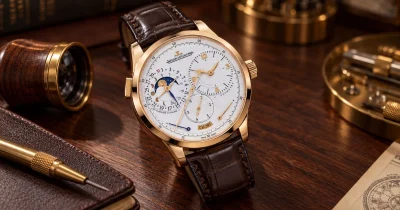
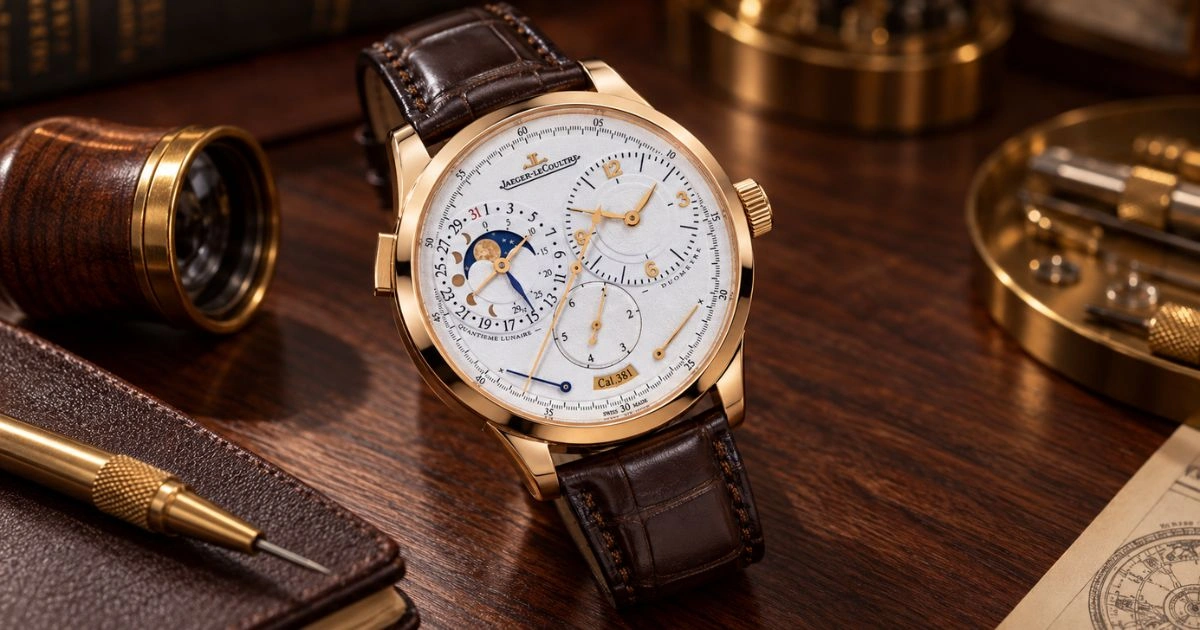
The same logic extends to other complications. In the Duometre à Quantième Lunaire, one power supply is dedicated to the timing foundation regulated by the escapement and balance, while the other serves the display of time, date, and moon phase, with the two synchronized through a jumping seconds mechanism. In the more recent Chronograph Moon, Calibre 391 gives each wing its own 50-hour power reserve and uses the complication wing to drive the chronograph, the moon phase, and the night-day display. The principle remains consistent even as the complications change.
How the Mechanism Improves Timekeeping Precision
Protecting Isochronism
The central technical benefit of the dual-barrel system is the protection of isochronism. Isochronism is the property that allows a balance wheel to oscillate with the same period regardless of changes in amplitude or driving force. In practice, no mechanical watch is perfectly isochronous, but a stable and constant supply of energy makes isochronism far easier to achieve. By separating the power supply, the Duometre ensures that the escapement receives energy from a dedicated source that is not being tapped by other functions. The result is a timekeeping chain that behaves more like a precision chronometer than like a conventional complicated watch.
The Jumping Seconds Connection
The Duometre’s precision story is reinforced by its treatment of seconds display. In several models, the seconds hand advances in jumping increments—typically six steps per second—rather than sweeping continuously. This is not merely an aesthetic choice. The jumping seconds mechanism is driven by the escapement and provides a visible confirmation of the regularity of the regulating organ. In the Quantième Lunaire, the jumping seconds hand allows the time to be set with accuracy to the nearest one-sixth of a second, and a zero-reset function causes the seconds hand to jump to twelve o’clock when the crown is pulled, simplifying synchronization with a time signal. The chronograph models extend this logic with a seconde foudroyante, a flying seconds hand that completes one revolution per second in six discrete jumps, turning the escapement’s rhythm into a visible fraction-of-a-second display.
Chronometer-Worthy Ambition
Jaeger-LeCoultre has consistently described the first Duometre movement, Calibre 380, as capable of displaying time with chronometer-worthy precision. The phrase is carefully chosen. It does not claim that every Duometre is a certified chronometer; it claims that the architecture removes the obstacle that ordinarily prevents a complicated watch from achieving chronometer-level performance. The dual-barrel system is the foundation of that ambition, and the Maison’s internal 1,000-hour control testing—which exceeds official chronometry tests and covers the movement before and after casing—further underscores the seriousness with which the Duometre’s precision is treated.
Key Duometre Models and Movement Variations
The Founding Calibre and Its Descendants
The Duometre family has evolved through several distinct calibres, each applying the dual-wing principle to a different set of complications. Calibre 380, introduced in 2007, established the template with a manually wound chronograph, twin barrels, dual power-reserve indicators, and a jumping seconds display. Calibre 381 followed in the Quantième Lunaire, pairing the dual-wing architecture with a date and moon-phase display and a zero-reset jumping seconds system. Calibre 382 brought the concept to the Sphérotourbillon, combining the dual-wing layout with a multi-axis tourbillon.
The Modern Generation
More recent additions have expanded the collection in new directions. Calibre 388, introduced in the Duometre Heliotourbillon Perpetual, pairs the dual-barrel architecture with a triple-axis tourbillon and an integrated perpetual calendar with a large date, running at 4 Hz to further support chronometric performance. Calibre 391, launched in 2024 for the Duometre Chronograph Moon, is a fully integrated manually wound movement that combines a monopusher chronograph, moon phase, night-day display, seconde foudroyante, and two power-reserve indicators, all built on the same two-barrel, two-train, single-escapement foundation. Across these variations, the dual-barrel principle remains the constant: whatever the complication, it gets its own source of energy so that timekeeping does not have to share.
Why the Duometre Matters to Watch Collectors
A Solution, Not a Spectacle
Many complicated watches impress through the sheer number of functions they stack onto a dial. The Duometre impresses for a different reason: it identifies a real mechanical problem and solves it at the level of architecture. Collectors who value movement design often gravitate toward the Duometre because its dial layout directly expresses its mechanics. The triangular arrangement of counters, the twin power-reserve displays, and the visible gear trains are not decorative flourishes; they are a map of how the watch works. The movement itself is hand-finished with brushed surfaces, perlage, hand-bevelled edges, and radiating Geneva stripes, and even components hidden beneath the bridges receive the same attention.
Historical Resonance and Technical Rarity
The Duometre also carries a sense of historical continuity. Its twin-barrel layout echoes the 1881 Calibre 19/20RMSMI, connecting a twenty-first-century solution to a nineteenth-century experiment. At the same time, the dual-wing concept is genuinely rare in the broader market. Very few movements separate the power supply for timekeeping and complications while still sharing a single regulating organ, and even fewer do so with the coherence of the Duometre. For collectors who are drawn to watches that reward close looking and technical understanding, the Duometre offers a combination of intellectual depth and wearable refinement that is difficult to find elsewhere.
Conclusion
The Jaeger-LeCoultre Duometre is best understood not as a collection of complicated watches but as a single, rigorous idea expressed in multiple forms. Two barrels, two gear trains, one escapement: that is the core of the dual-wing architecture, and it is the reason the Duometre can welcome a chronograph, a moon phase, a perpetual calendar, or a triple-axis tourbillon without compromising the regularity of its timekeeping. The dual barrels are not simply redundant energy storage; they are the mechanism’s way of keeping the timekeeping chain sovereign. For enthusiasts, that makes the Duometre a watch worth studying as well as wearing—a reminder that in haute horlogerie, the most meaningful complications are often the ones that happen beneath the dial, in the architecture of the movement itself.