Editorial
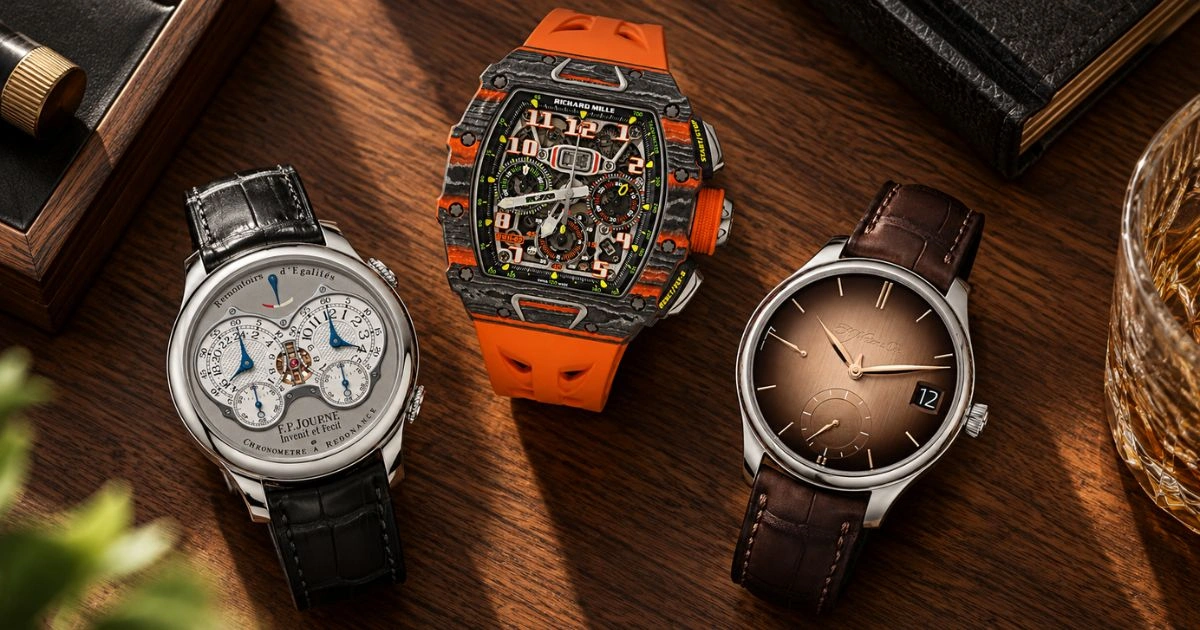
In an industry dominated by global conglomerates and household names, a quiet revolution has been unfolding at the workbench. Independent watchmaking—the pursuit of horological creation outside the structures of large corporate groups—has moved from a niche curiosity to one of the most vital forces in modern watch collecting. These are the ateliers where a single mind might conceive a movement, a pair of hands might finish every bridge, and a small team might produce only a handful of watches in a year.
The appeal is not merely rarity, though rarity is certainly part of it. Independent watchmakers operate with a freedom that few mainstream brands can afford. They can pursue a technical obsession for a decade without a marketing department asking for a return. They can design a case that looks like nothing else on the market. They can finish a movement to a standard that would be economically impossible at scale. For collectors, these watches represent something increasingly precious: an authentic, unfiltered connection to the person who made them.
Yet the world of independents can feel daunting. Names are whispered between collectors, waiting lists stretch into years, and technical language is often dense. This guide is designed to cut through that intimidation. What follows is not a ranking, nor a definitive list. It is an introduction to ten independent watchmakers whose work has shaped the landscape—some rooted in centuries-old tradition, others determined to break every rule. Together, they offer a map of what independent watchmaking can be.
What Makes Independent Watchmakers Different?
The term “independent” is broader than it once was. Historically, it referred to watchmakers who belonged to the Académie Horlogère des Créateurs Indépendants (AHCI), an association founded in 1984 to support creators working outside the mainstream industry. Today, the definition is looser. Some independents are family-owned manufactures with dozens of employees. Others are essentially one-person operations. Some own their case and dial suppliers; others collaborate closely with external specialists.
What unites them is a different set of priorities. Large brands design for a global market, optimise for production efficiency, and build collections around commercial tiers. Independents design from a personal vision. Their production is small, their development cycles are long, and their finishing is often executed with a level of handwork that mass production cannot replicate. The result is a landscape of extraordinary diversity: a watch from Philippe Dufour and a watch from Richard Mille share almost nothing aesthetically, yet both exist because their creators were free to pursue a singular idea.
This freedom comes with trade-offs. Independent production is slow, distribution is limited, and servicing can require a direct relationship with the maker. But for many enthusiasts, those constraints are part of the value. The watch is no longer an anonymous product of a supply chain. It is the expression of a philosophy.
10 Independent Watchmakers You Should Know
F.P.Journe: Precision Through Resonance
François-Paul Journe began making tourbillons at twenty and designed a planetarium at twenty-two, but his defining achievement is a mechanism that seems to defy the practical limits of a wristwatch. The Chronomètre à Résonance, commercialised in 2000, uses two balance wheels that interact through acoustic resonance. Each balance alternately excites and stabilises the other, allowing them to beat in opposition and support each other’s inertia. The effect is a self-correcting system: when an external disturbance accelerates one balance, it simultaneously slows the other, and the two gradually return to harmony.
Journe’s philosophy is rooted in eighteenth-century horology—he drew inspiration from Antide Janvier—but applied with a modern understanding of wear and shock. The brand’s movements are also notable for their use of 18-karat rose gold, a material Journe adopted for his haute horlogerie calibres beginning in 2004. For collectors, F.P. Journe represents technical audacity combined with an unmistakable aesthetic language: off-centre displays, exposed mechanics, and a case profile that is immediately recognisable.
Philippe Dufour: The Conscience of Finishing
If independent watchmaking has a moral centre, it is Philippe Dufour. Trained as a restorer of antique pocket watches, Dufour learned by observing how past masters achieved complexity with simple tools. That education shaped a philosophy of uncompromising hand-finishing and architectural clarity. His Simplicity, launched in 2000, is a time-only watch with hours, minutes, and small seconds—and yet it took roughly twelve years to produce the approximately 200 pieces in the collection.
The movement is finished to a standard that has become a benchmark: Côtes de Genève, mirror polishing, and chamfering applied not only to bridges but to screws, screw slots, and even wheel teeth. Dufour also created the Duality in 1996, the first wristwatch with a double escapement, and earlier integrated a grande sonnerie with a minute repeater into a wristwatch in 1992. Collectors regard Dufour’s work as a living link to a pre-industrial standard of craftsmanship—proof that a watch can be both mechanically rigorous and visually serene.
Kari Voutilainen: The Watchmaker’s Watchmaker
Kari Voutilainen is often called the watchmaker’s watchmaker, and the description fits. Since founding his atelier in 2002, the Finnish-born horologist has built a vertically integrated manufacture that produces almost every component of its movements in-house, save for balance springs, main springs, and jewels. His workshop produces only around sixty watches per year, each finished with traditional techniques such as anglage and perlage.
Voutilainen’s technical signature is the double direct natural escapement, introduced in the Vingt-8 in 2011. It provides a direct impulse to the balance and requires less energy than a conventional Swiss lever escapement, improving stability and durability. Equally important is his aesthetic signature: hand-guilloché dials, often in rich, deep colours, executed with an engine-turned precision that few ateliers can match. His watches are classical in proportion but quietly radical in construction—a combination that has earned him a devoted following among collectors who value both beauty and engineering.
Greubel Forsey: The Architecture of the Tourbillon
Robert Greubel and Stephen Forsey founded their atelier in 2004 with a mission to reimagine the technical and aesthetic fundamentals of fine watchmaking. Their first invention, the Double Tourbillon 30°, placed a cage inclined at 30 degrees inside a second, level cage rotating every four minutes. This arrangement was designed to optimise the average timing rate across all positions of the watch.
Greubel Forsey’s work is characterised by three-dimensional movement architecture, visible from both the dial side and the case back. The Tourbillon 24 Secondes made the escapement the star of the watch, an approach not seen since the tourbillon was patented in 1801. The brand is also known for its commitment to hand-finishing and for experimental projects such as the EWT laboratory, which explores avant-garde mechanics. For collectors, Greubel Forsey represents the outer edge of technical ambition in traditional haute horlogerie—watches that feel like sculptures built around a beating heart.
Laurent Ferrier: Neoclassical Precision
Laurent Ferrier spent thirty-seven years at Patek Philippe, rising to head of product development, before founding his own brand in 2009. That pedigree is visible in the brand’s refined, almost minimalist cases and dials, but the real story is underneath. Ferrier’s Galet Classic Tourbillon Double Spiral won the men’s watch prize at the Grand Prix d’Horlogerie de Genève in 2010, the brand’s debut year.
The signature technical element is the micro-rotor calibre introduced in 2011, which allowed Ferrier to offer an automatic movement with the slim profile of a hand-wound watch. More unusually, the micro-rotor movement incorporates a natural escapement—a low-friction design inspired by Abraham-Louis Breguet that gives a direct impulse to the balance and operates with less lubrication than a conventional lever escapement. Ferrier’s watches are classical in appearance but quietly inventive in execution, appealing to collectors who want traditional elegance without traditional compromises.
MB&F: Horological Machines and Kinetic Art
Maximilian Büsser founded MB&F in 2005 as the world’s first horological concept laboratory. The name stands for Maximilian Büsser & Friends, and the “Friends” are the independent watchmakers, designers, and manufacturers with whom he collaborates on each project. MB&F produces two broad families: Horological Machines, which are three-dimensional, sculptural objects that tell the time in unconventional ways, and Legacy Machines, which reinterpret nineteenth-century complications with a contemporary sensibility.
The brand’s designs are deliberately radical. The HM7 Aquapod, inspired by a jellyfish, uses a spherical time display with two rotating rings and a central flying tourbillon, dispensing with traditional hands entirely. For collectors, MB&F offers something rare in luxury watchmaking: a sense of play. These are not watches designed to blend in. They are kinetic art objects that happen to keep time, and they have built a community around the idea that horology can be joyful as well as serious.
De Bethune: Technical Silence and Celestial Aesthetics
Denis Flageollet and David Zanetta founded De Bethune in 2002 with the stated aim of reinventing watchmaking for the twenty-first century. The brand draws on centuries of horological culture—its name honours a eighteenth-century French nobleman and watchmaking innovator—but applies modern materials and scientific methods to movement architecture. Flageollet describes the goal as “technical silence”: complicated pieces that remain sober and legible despite their complexity.
De Bethune is known for its silicon escapement components, which reduce friction and energy loss, and for its three-dimensional moonphase displays, which use two hemispheres of steel and palladium to render the lunar cycle with unusual depth. The brand’s aesthetic is futuristic but organic, often featuring blued titanium, floating lugs, and a distinctive deep blue finish that has become a signature. Collectors are drawn to De Bethune for its willingness to rethink familiar complications—moonphase, tourbillon, power reserve—through a lens that feels both ancient and science-fictional.
H. Moser & Cie.: Minimalism with an Irreverent Edge
H. Moser & Cie. traces its roots to 1828, when Heinrich Moser established a watchmaking business in St. Petersburg. The modern brand, however, was rebuilt after 2012, when the Meylan family acquired a company on the verge of bankruptcy and set about transforming it into one of the most distinctive voices in independent watchmaking. Under CEO Edouard Meylan, Moser embraced a strategy of provocation, humour, and transparency—releasing concept watches without logos, using social media with unusual directness, and positioning itself as an antidote to corporate stuffiness.
The watches themselves are exercises in reduction. The Endeavour Perpetual Calendar is a celebrated example of complexity made simple, with an intuitive display that hides the underlying mechanical ingenuity. The Streamliner collection, launched in 2020, brings the brand’s minimalism into an integrated-bracelet sports watch with fluid, automotive-inspired lines. Moser appeals to collectors who want haute horlogerie without the self-importance—watches that are technically serious but wear their seriousness lightly.
Urwerk: Reimagining How Time Is Read
Felix Baumgartner and Martin Frei founded Urwerk in 1997 with the ambition to imagine fine watchmaking of the future rather than copy it from the past. Their breakthrough came with the UR-103 in 2003, which displayed time using four orbiting satellites instead of traditional hands, turning the act of reading the time into a sensory experience. The brand’s satellite hours system remains its signature: rotating carousel arms carry hour indicators that sweep past a minute track, creating a dynamic, almost mechanical theatre on the wrist.
Urwerk’s watches are also instruments. The UR-201, introduced in 2007, added a control board for fine regulation, a lifetime counter tracking the movement’s total years of operation, and an oil-change service indicator—an industry first. The cases are often inspired by natural forms or aerospace design, and the finishing is meticulous despite the unconventional architecture. For collectors, Urwerk represents the purist strand of independent avant-gardism: watches that challenge the very grammar of horological display.
Richard Mille: Engineering as Luxury
Richard Mille launched his eponymous brand in 1999 after a career that included leading the watch division at Mauboussin. From the beginning, his goal was to break with classical watchmaking and apply engineering thinking to every element of the watch. The RM 001 Tourbillon, presented in 2001, established the template: a tonneau-shaped case, a skeletonised movement, and a design language drawn from motor racing and aeronautics.
The brand is known for its use of advanced materials—titanium, carbon fiber, ALUSIC (a material used in satellites), and proprietary composites developed with partners such as McLaren. Its movements are built for shock resistance and ease of maintenance, and its cases are designed around the movement rather than the other way around. Richard Mille watches are polarising: some see them as the future of performance horology, others as excess. But there is no denying their influence. They have expanded what a luxury watch can look like and what materials it can be made from, and they have attracted a new generation of collectors who value technical innovation as much as tradition.
How to Choose an Independent Watch Brand
Choosing an independent watch is different from choosing a mainstream luxury watch. The first question is not “Which model is most popular?” but “Whose philosophy do I want to live with?” Read about the maker. Look at how the watches are finished, not just how they photograph. Consider the movement architecture: is it designed for visual interest, for chronometric performance, or for both? Think about wearability—independents often have distinctive case shapes and proportions that feel very different on the wrist than in a display case.
Practical factors matter too. Independent production is limited, so waiting times can be long, and servicing may require returning the watch to the atelier. Some brands have broader service networks than others. It is also worth understanding the level of in-house production. A brand that makes its own escapements and dials operates differently from one that assembles components from specialist suppliers—neither approach is inherently better, but the distinction affects how the watch should be understood and maintained.
Finally, trust your response to the object. Independent watchmaking is personal, and the watches are designed to be personal. The right choice is the one whose details you keep noticing—the finishing on a bridge, the curve of a lug, the way the light catches a dial—long after the novelty of ownership has passed.
Independent Watchmaking and Collectibility
Collectibility in independent watchmaking is not a simple equation. It is not about production numbers alone, nor about brand recognition in the conventional sense. It is about the coherence of a maker’s vision, the consistency of execution, and the watch’s place within a body of work. A Philippe Dufour Simplicity is collectible because it represents the purest expression of its maker’s philosophy. A Greubel Forsey tourbillon is collectible because it advances a technical lineage. An MB&F Horological Machine is collectible because it captures a moment of unfiltered creativity.
This does not mean every independent watch will be sought after forever. Tastes change, and the field is broad. What matters is understanding why a particular watch exists and what problem or idea it embodies. Collectors who approach independents with curiosity rather than speculation tend to build collections that feel meaningful—not because they followed a market, but because they followed a thread of genuine interest.
Conclusion
Independent watchmaking is not a single style or a single philosophy. It is a space where tradition and experimentation coexist, where a watchmaker can spend a decade perfecting an escapement or a single afternoon deciding the exact shade of a dial. The ten names in this guide represent only a fraction of that space, but they illustrate its range: from Dufour’s quiet perfectionism to Mille’s engineering maximalism, from Voutilainen’s hand-guilloché classicism to Urwerk’s orbiting satellites.
For enthusiasts and beginners alike, the value of independent watchmaking lies in what it reveals about watches as objects of human intention. These are not anonymous products. They are arguments about how time should be measured, displayed, and experienced—made by people who have chosen to work at a smaller scale so that they can work with greater freedom. Learning to read those arguments is one of the most rewarding journeys in horology, and these ten names are a place to begin.